Valtournenche

Edited by:
Massimo Martini
Access
Valtournenche can be reached from Aosta by taking the Valtournenche state road , which runs up the side valley of the same name from the main valley floor. The connection with the motorway network is via the Turin-Mont Blanc motorway, at the Châtillon-Saint-Vincent toll booth, from where it continues northwards on the for around twenty kilometres to the municipal capital of Paquier. The nearest railway station is Châtillon, on the Turin-Aosta line operated by Trenitalia (TI); bus connections to the valley depart from the station square. The public transport service is guaranteed by bus lines connecting the valley floor with the hamlets and the village of Breuil-Cervinia throughout the year, with increased frequency during the high winter and summer seasons.
.Introduction
Valtournenche is the main municipality of the side valley of the same name in Valle d'Aosta, which runs northwards from the bottom of the Dora Baltea valley towards the Matterhorn massif. The main town, Paquier, is located at an altitude of 1,528 metres, on an alluvial plateau that separates the middle part of the valley from its upper section, characterised by a gradual narrowing of the rock walls. The municipal territory extends over more than one hundred and sixteen square kilometres, including numerous hamlets and villages distributed at different altitudes, up to the Breuil-Cervinia basin, located at more than two thousand metres. The earliest traces of human habitation date back to prehistoric times; the valley acquired documented importance in the Middle Ages, when the Teodulo pass, at 3,322 metres, was a transit route also used by herds, serving as a link between the Valle d'Aosta valleys and the corresponding Swiss valleys on the northern side of the Alps. Today, the municipality's identity is predominantly marked by its tourism vocation linked to the mountains, in particular the attraction of the Matterhorn and the ski area that includes Breuil-Cervinia.
.Description
The territory of Valtournenche occupies the entire development of the valley of the same name, from its confluence with the Dora Baltea to the glaciers surrounding the Matterhorn to the north. The morphology is the classic one of a lateral glacial valley: a flat bottom in its middle section, steep walls with rocky steps, and a series of side valleys that open up towards the peaks of the Swiss border to the east and the Val d'Ayas to the west. The main stream is the Marmore, which runs the length of the valley before flowing into the Dora Baltea near Châtillon.
Prehistoric settlement traces are documented in several places in the valley. In the Middle Ages, Valtournenche was part of the orbit of the local lords and bishops of Aosta, and the Teodulo pass exercised an important transit function for transalpine trade. In the following centuries, the valley remained a predominantly agro-pastoral reality, with an economy based on livestock farming and the use of seasonal mountain pastures.
The turning point in the history of the municipality is linked to the season of 19th-century mountaineering and, in particular, to the first ascent of the Cervino. On 14 July 1865, Edward Whymper reached the summit via the Lion Ridge with a mixed Anglo-Swiss rope team; two days later Jean-Antoine Carrel, a mountain guide from Valtournenche, completed the same ascent via the Italian ridge with a rope team from Valle d'Aosta. The rivalry between the two ventures and the events of Whymper's descent - during which four members of the rope team lost their lives - had an international resonance that brought the Matterhorn and the Breuil basin to the centre of European mountaineering attention. From that moment on, Valtournenche became one of the most frequented destinations in the Western Alps, with a constant influx of mountaineers and later tourists.
The development of the Breuil basin as a modern tourist resort began in the 1930s, with the construction of the carriage road in 1934 and the first ski lifts in 1936. In the post-war period, the basin saw a rapid and disorganised building expansion that profoundly changed the built landscape. The resort, renamed Breuil-Cervinia, is now connected to the ski area of Zermatt, on the Swiss side, through the crossing of the Teodulo pass; the total number of slopes that can be crossed on both sides amounts to over 350 kilometres. Skiing is also possible in summer thanks to the permanence of snow on the glaciers at altitudes above 3,000 metres.
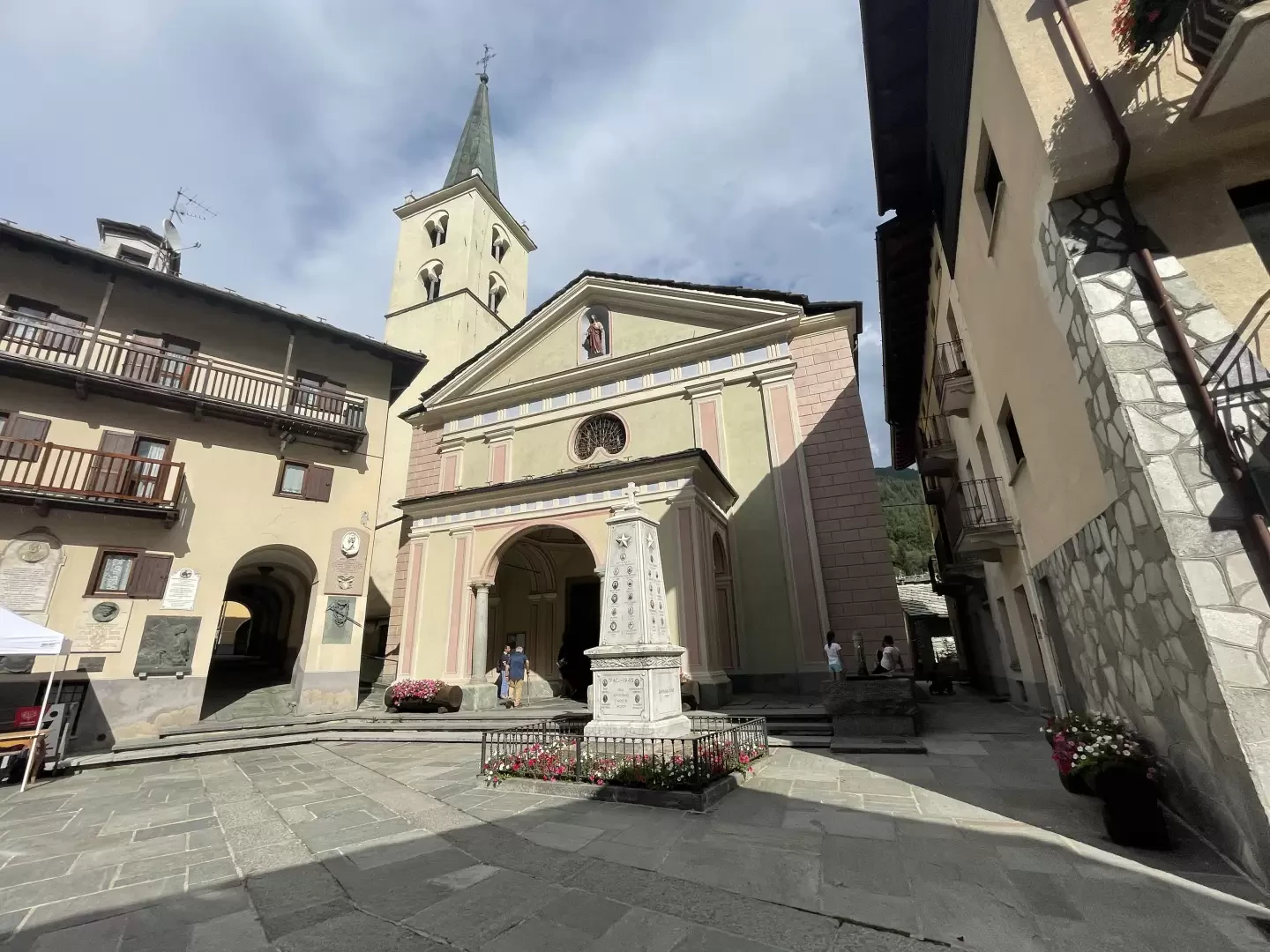
The valley floor and intermediate altitudes of the municipality preserve a fabric of villages and hamlets with traditional stone and wood architecture. Numerous alpine pastures are still active in the summer season. From a hiking point of view, the valley offers a network of trails connecting the hamlets on the valley floor with the side valleys and the border passes. The colle del Teodulo can also be reached on foot from the Breuil-Cervinia basin and is one of the most easily accessible alpine passes in the entire western Alps. The trail network includes routes suitable for classic hiking, winter ski mountaineering routes and snowshoe trails.
.Information
General Data
Area: 116.15 km²
Main town elevation: 1,528m
Maximum elevation: 4,478m - Cervino
Number of inhabitants: 2.176 (as at 30.04.2024)
Name in dialect: Vótornéntse
Name of the inhabitants: valtourneins
Patron saint: Sant'Antonio Abate
Neighbouring municipalities: Antey-Saint-André - Ayas - Bionaz - Chamois - Torgnon
Province of origin: Valle d'Aosta
Region of affiliation: Valle d'Aosta
Nationality: Italy
Institutional site: www.comune.valtournenche.ao.it